
North Carolina food-trailer startup guide · Official-source review September 29, 2026
Short answer: Start with the complete menu, proposed commissary arrangement and first operating address. The county environmental-health office that reviews the commissary relationship is central to the mobile food unit permit, while the city or county controlling the vending site handles separate land-use questions. Charlotte and Raleigh use different site-permit paths. Get both answers before fixing the equipment plan or ordering the final build.
North Carolina's current mobile food rules also require the permit holder to give the issuing authority a list of operating counties and locations, then notify each county before service begins there. A county food permit does not make every parking lot legal, and a city vending permit does not approve the food operation.
Official state, Mecklenburg County, Charlotte and Raleigh sources were checked on September 29, 2026. This is a project-planning guide, not legal, tax, fire-protection or licensing advice. The responsible authorities and the documents issued for your menu, unit and sites control the answer.
01Route the menu to the right food authority
Most restaurant-style mobile food units begin with county environmental health. The North Carolina Department of Agriculture and Consumer Services directs restaurants and catering operations to county health departments, while packaged foods, meat and poultry, seafood, dairy and frozen desserts may involve one of its own programs. A mixed menu can cross those categories.
Send the written menu and food flow to the county before treating the agency route as settled. Include where raw ingredients arrive, what happens at the commissary, which steps occur on the trailer, how food is cooled or reheated and whether any product will be packaged for wholesale or later sale.
The menu controls the equipment discussion. If it is still changing, do not lock sink sizes, refrigeration, hot holding, ventilation or service-window details. Ask the reviewing authority to identify the current application and rule path for the actual operation.
02Resolve the commissary relationship before layout approval
G.S. 130A-248(c1) describes two mobile-unit routes: the unit can meet all sanitation requirements of a permitted commissary, or it can use a permitted restaurant or commissary as its base of operation. The current rule compilation, 15A NCAC 18A .2670, describes a permit issued by the authority that inspects the commissary and daily reporting for supplies, cleaning and servicing.
Those provisions need a project-specific reading. Give the county the proposed unit design and commissary arrangement, then ask which route it will accept and what must happen at each location. Keep the response in writing.
For a separate commissary, inspect the contract and the physical space together. Confirm potable-water loading, wastewater disposal, food and utensil storage, cleaning, servicing, parking and any food-preparation work assigned to the base. A rental agreement alone does not show that the location can perform those functions for your operation.
North Carolina's rule also requires an operating-county and location list. Before serving in a new county, provide that county's authority with the proposed locations and keep the list current. Ask whether the county wants a form, email, portal submission or added review. Do not assume notice replaces a permit, inspection or site approval that another authority requires.
03Turn the food application into the design brief
Rule .2672 gives concrete mobile-unit design inputs. It addresses protection from contamination, pressurized hot and cold potable water, a handwashing sink, utensil washing, sewage storage and commissary servicing. It also says the wastewater tank must be at least 15 percent larger than the water-supply tank when onboard storage is used.
Treat those provisions as review inputs, not a universal equipment package. The same rule allows an equipment-sink exception when no food is prepared on the unit and utensils are effectively cleaned at the commissary. The authority decides whether the exception fits the submitted menu and process.
Build a schedule that names each item instead of labeling boxes on a floor plan:
- record the manufacturer, model, dimensions and utility load for each appliance;
- show the potable-water inlet, hot-water system, hand sink, utensil sink and tank capacities;
- map raw-product storage, preparation, cooking, holding, service and waste movement;
- identify ventilation, suppression, LP-gas, electrical and generator or shore-power interfaces;
- leave service access for filters, valves, drains, panels and equipment removal.
The state Plan Review Unit lists scaled plans, menu and manufacturer specification sheets among its submission items. Its page currently lists a $250 fee for reviews handled by that state unit. A local county route may use different forms, fees and timing, so confirm the destination before paying or sending plans.
04Check the first address through both approval lanes
Use one proposed location to expose site problems early. Photograph the parcel from the entry, service side and exit. On a simple site sketch, mark the trailer, tow vehicle, customer line, accessible route, fire access, trash, grease, generator or shore-power point and employee restroom route.
Then send the same address to the food authority and land-use authority. Their reviews answer different questions.
| Decision | Charlotte / Mecklenburg County | Raleigh / Wake County |
|---|---|---|
| Food permit and plan review | Mecklenburg County Environmental Health publishes a mobile food and pushcart application packet and plan-review resources. | Wake County Environmental Services publishes a mobile food unit application checklist and uses its permit portal. Confirm the current packet and required commissary record before submission. |
| Private-property site | Charlotte lists Mobile Food Vendor among uses requiring a city Zoning Use Permit after applicable outside-agency approvals. | Raleigh treats food trucks on private property as mobile retail. The vendor needs its permit, and the host property needs the applicable mobile-retail approval. |
| Public right-of-way or event | Ask Charlotte which vending or event path applies to the exact site; a zoning use permit is not blanket street-vending permission. | Raleigh has a separate, limited right-of-way route and separate temporary-event treatment. The city's current page identifies designated areas and supporting records. |
| Power decision | Give zoning and fire reviewers the proposed fuel and power plan before fixing equipment locations. | Raleigh's long-term mobile-retail standards require electrical service and prohibit portable generators. That condition should not be generalized to short-term sites or other jurisdictions. |
| Timing | Charlotte publishes gateway and review targets on its current permitting page. Treat them as planning information, not an approval date. | Raleigh requires a plan-review fee before review and collects other fees at issuance. Use the live fee guide and portal for the current amount. |
Charlotte's permitting page currently identifies Mobile Food Vendor as a Zoning Use Permit category. It publishes a three-business-day gateway target and a 10-business-day permit-review target, with another review cycle if changes are needed. Those are city targets, not a promised opening schedule.
Raleigh's food-truck page says county and state food-service permits come before the city application. Its mobile-retail page separates short-term and long-term private-property paths and assigns permits to both the vendor and host property. Test the actual parcel against the current route.
05Keep food, fire, site and vehicle records separate
The county food review does not settle fire, electrical, plumbing, zoning, event or vehicle questions. Name the authority and record for each decision. If LP-gas or cooking suppression is involved, ask the fire or code authority having jurisdiction which current review and inspection it expects.
The NCDA&CS Standards Division page checked September 29, 2026 says its North Carolina food-truck LP-gas inspection program is suspended until further notice. Do not turn that notice into a claim that no LP-gas or fire review applies. It means the operator needs a current answer from the applicable fire or code authority and LP-gas supplier rather than promising an NCDA&CS food-truck inspection.
Vehicle documents belong in another file. Keep the VIN, manufacturer or origin record, certification-label photographs, axle and brake data, ratings, title, registration, insurance and driver requirements with the physical unit. A sanitation permit does not approve highway use, and a vehicle record does not authorize food service.
06Register the business and tax accounts on their own track
Entity choice is a legal and tax decision. The North Carolina Secretary of State explains which corporations, limited liability companies and partnerships must register with the state. A sole proprietorship or general partnership may instead need an assumed-name filing with the county Register of Deeds. Confirm the path for the chosen structure rather than assuming every operator needs an LLC.
The North Carolina Department of Revenue provides online sales-and-use tax registration and states that applying for a Certificate of Registration has no fee. Its current food guidance treats prepared food as non-qualifying food subject to the general state rate plus applicable local and transit rates. Register the correct accounts, verify the rate for each sourcing situation and keep tax setup separate from the food and site permits.
If you hire staff, add payroll, unemployment-insurance and workers' compensation questions before opening. Insurance should match the tow vehicle, trailer, cooking operation, staff, property agreement and event contracts. A certificate requested by one host does not establish that every risk is covered.
07Coordinate the MOBITRUCK shell and the U.S. final build
MOBITRUCK prepares the shell system at its production facility in Estonia. In the current U.S. path, Concession Nation assembles the rolling shell, assigns the American VIN and performs the applicable vehicle-certification work for its stage with the specified running gear. Concession Nation can complete the final build, or another qualified U.S. builder can take a documented rolling shell under a separate scope.
North Carolina authorities still decide whether the menu, commissary relationship, equipment, utilities and operating sites meet their requirements. Send current authority comments to the builder before sinks, tanks, ventilation, fuel components, appliances or service openings are fixed.
If another builder completes the unit, write the handoff into both contracts. Identify who buys each appliance, performs each trade scope, responds to authority comments, supplies test records and warrants the work. The shell and builder guide explains that responsibility boundary.
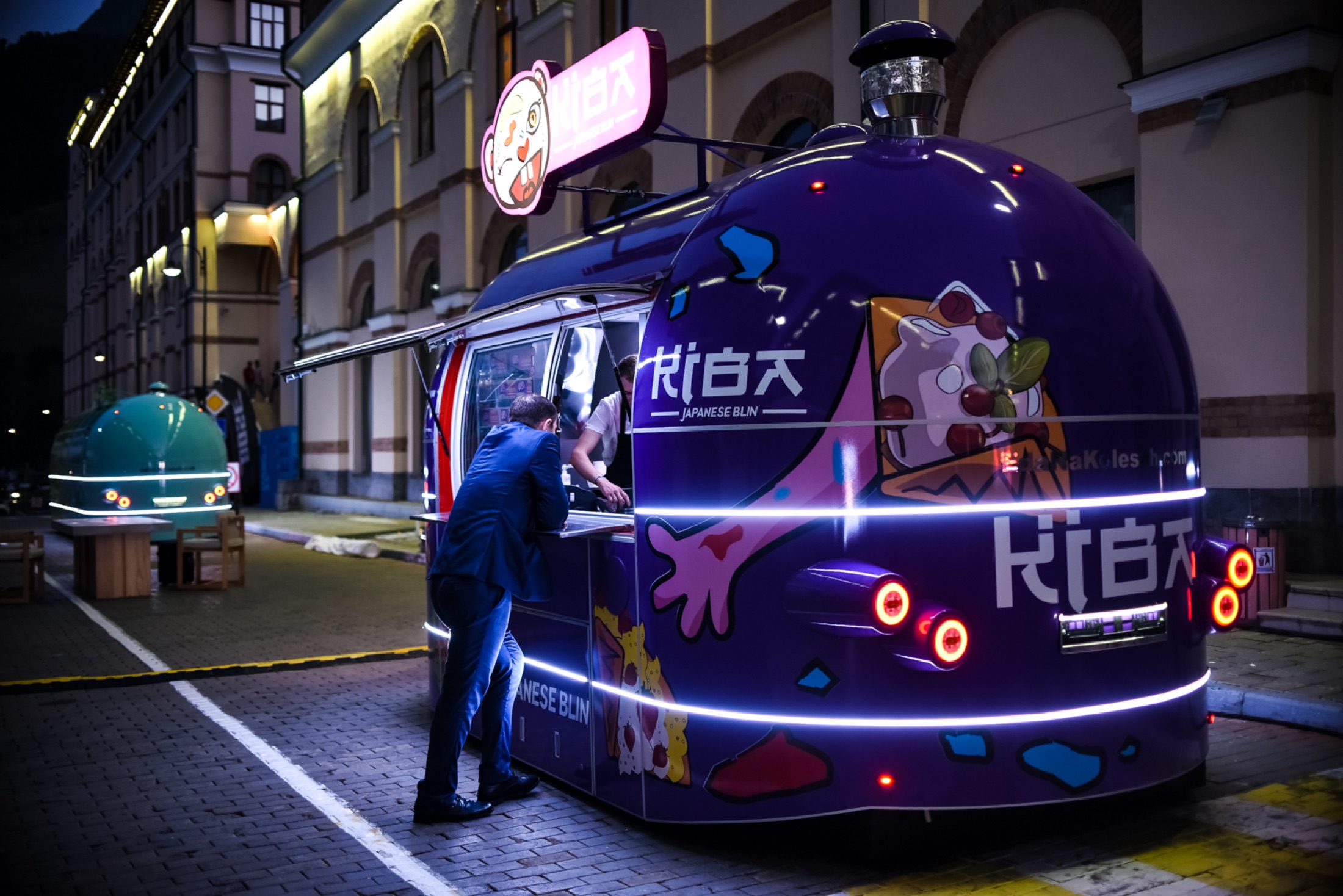
The photograph on this page is an owner-approved MOBITRUCK archive image of a commercial trailer platform inside the production facility. It is a construction reference. The image was not documented as a North Carolina project and does not prove a permit, inspection or operating approval.
08Build an opening file tied to the unit
Keep one digital folder and one delivery checklist tied to the VIN and physical labels. Include the records that apply to the project:
- approved menu, commissary record, unit plan and equipment specification sheets;
- mobile food unit permit, inspection records and the current operating-county and location list;
- property authorization plus city, county, fire, event and trade records for each recurring site;
- water, wastewater, electrical, LP-gas, ventilation and suppression documents that were actually issued;
- VIN, origin or manufacturer record, certification-label photographs, axle and brake data, title, registration and insurance;
- final drawings, equipment manuals, test records, warranties and an open-item log.
Do not label a builder checklist as a government inspection. Record the issuer, date, unit identifier and scope for every document. If the menu, commissary, ownership, equipment or operating locations change, ask the responsible authority whether the approval file must change too.
09A practical first 30-day work plan
During the first week, write the full menu and process, identify the proposed commissary route, choose one operating address and contact the county environmental-health office. Ask who will review the application and which current forms apply.
Next, send the actual address to the responsible city or county planning office. Add fire and event questions when the fuel, cooking process or venue makes them relevant. Convert every written response into the design-input register.
Use weeks two and three to assemble the unit layout, equipment models, tank calculations, utility loads and site sketch. Register the business and tax accounts in parallel, but do not treat those filings as plan approval.
Release irreversible construction only when the menu, commissary and first-site routes are clear enough to control the design. Before opening, close the inspections and records that apply to the food operation, site, fire or trade work, vehicle, insurance, taxes and employees.
10Questions North Carolina food-trailer founders ask
Do I need a commissary for a North Carolina mobile food unit?
The statute describes a self-commissary route for a unit that meets all sanitation requirements of a permitted commissary, or a separate permitted restaurant or commissary base. The current rule also describes daily commissary servicing. Give the design and menu to the permitting county and obtain its current interpretation for the project.
Can I operate in several North Carolina counties with one permit?
The current rule says the permit holder provides the issuing authority with a list of operating counties and locations and notifies each county before beginning service there. Ask every involved county whether it requires a notice, form, review, inspection or other authorization. City zoning, property permission and event rules remain separate.
Is a Charlotte permit valid in Raleigh?
No city permit creates statewide site approval. Charlotte uses its zoning process for Mobile Food Vendor sites. Raleigh uses private-property mobile-retail permits and a separate limited right-of-way route. The county food-permit record also remains distinct from city land-use permission.
Can I use a portable generator at a Raleigh site?
It depends on the Raleigh route. The current long-term mobile-retail standards require electrical service and prohibit portable generators. Short-term, event and right-of-way paths have their own conditions. Confirm the exact site and permit type before buying or placing the power equipment.
Does the health permit approve the trailer's VIN or road use?
No. Food sanitation, site permission, fire and trade review, and vehicle records belong to different authorities. Keep each issued record in the unit file and do not use one as proof of another.
11Sources checked September 29, 2026
- North Carolina General Statutes, G.S. 130A-248: food-establishment permits and the mobile-unit commissary framework.
- North Carolina Rules Governing the Food Protection and Sanitation of Food Establishments: Rules .2670 and .2672 on permitting authority, operating-location notices, servicing and unit construction.
- North Carolina DHHS Plan Review Application Requirements and Tools: state-unit submission items and current fee.
- NCDA&CS Starting a Food Business: food-program routing by product and process.
- NCDA&CS LP-Gas Interests for Industry: current suspension notice for the department's food-truck inspection program.
- Mecklenburg County Food and Facilities Sanitation and Plan Review: mobile food unit packet, plan-review tools and county food route.
- City of Charlotte Zoning Permitting: Mobile Food Vendor category and published review targets.
- City of Raleigh Food Trucks on Private Property and the Public Right-of-Way, Mobile Retail and UDO Section 6.4.11: private-property, right-of-way, host-property, power and site routes.
- North Carolina Secretary of State Register Your Business: entity-registration and assumed-name routing.
- North Carolina Department of Revenue Sales and Use Tax Registration and Food, Non-Qualifying Food, and Prepaid Meal Plans: registration and prepared-food tax guidance.
12Next step: bring the North Carolina permit inputs to the project review
Send [email protected] one menu, the proposed commissary arrangement, the first North Carolina operating address, the target opening date and the preferred build path. MOBITRUCK and the selected U.S. builder can use those facts to define the shell, equipment interfaces, handoff records and questions that remain with North Carolina authorities.
Start the project brief or request a configured price, lead time and video call.
 Authority map
