Mobile retail authority navigator · Source review November 1, 2026
A usable quote request is a project packet. “Red mobile boutique” describes an appearance, but it leaves the shell team and final builder without the customer mode, product load, site assumptions, owner-supplied items and delivery boundary needed to define the work.
Use the downloadable packet on this page to assemble those inputs in one place. Mark each line as confirmed, assumption, open or not applicable, name the person who owns the answer and link the source file. A blank field can hide a scope gap. A field marked open tells the project team what must remain on hold.
This packet supports project review. It is not a price, proposal, engineering release, permit decision, accessibility determination, vehicle certification, schedule commitment or warranty statement. Configured pricing follows the reviewed information and the written scope offered for the actual project.
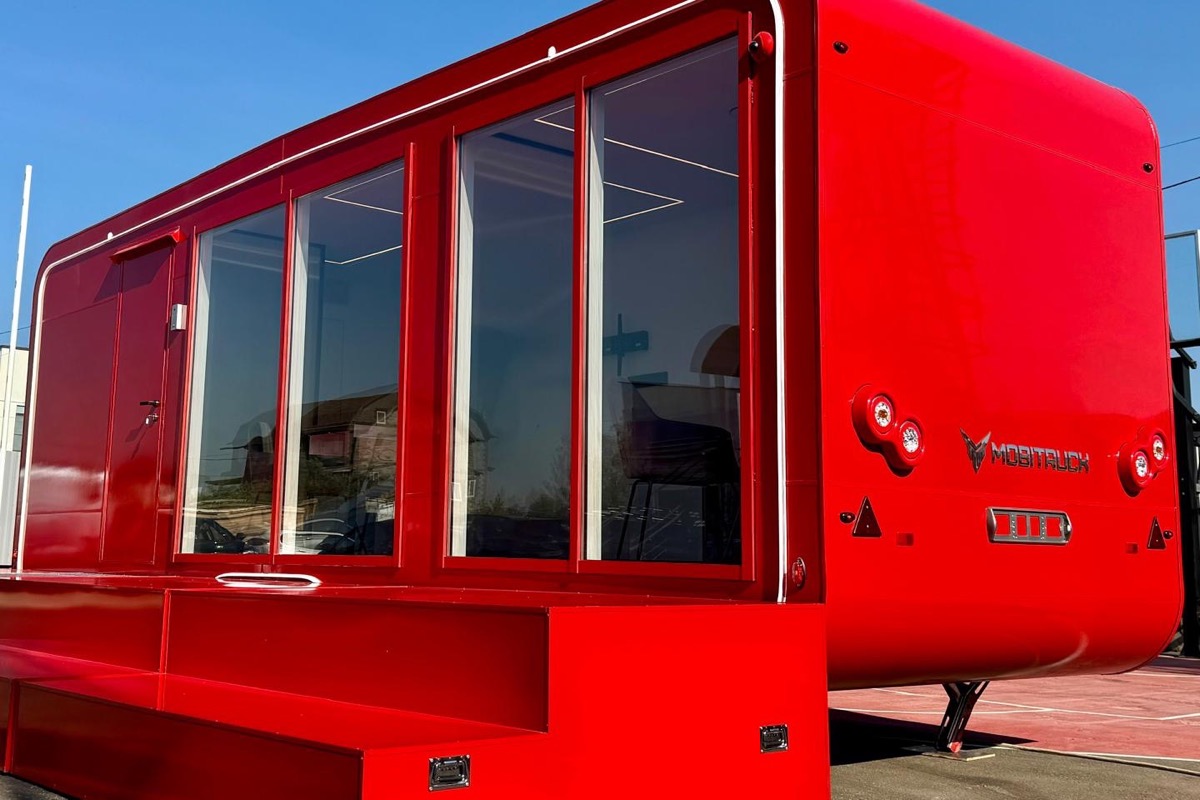
The selected photograph shows a real red MOBITRUCK retail unit with customer-side glazing and deployed entrance steps. It does not establish the model, dimensions, build location, operating location, equipment, approval status or scope for another project.
01Set the operating case first
Write one primary operating case before listing finishes. State whether customers enter, shop from outside, attend by appointment or use a hybrid arrangement. Add the product families, representative package sizes, expected staff positions and the work that occurs during replenishment, checkout and closing.
The description should be testable. For example: “Two staff receive customers by appointment, demonstrate four powered products, complete checkout near the exit and store packed inventory for travel.” That sentence gives the project team a customer mode, a staffing case, a demonstration load and a travel-state question. “Premium showroom” does not.
If the operating case is still changing, label it as an assumption. Do not release fixed openings, counters or equipment interfaces as confirmed work until the affected inputs are stable.
02Complete the six quote sections
The quote-input packet groups the buyer’s information into six sections. Each section has a release purpose beyond collecting preferences.
| Section | What the buyer submits | What it allows the project team to review |
|---|---|---|
| Project control | Legal buyer, project lead, decision contacts, target use and requested delivery level | Who can approve scope and which project stage is being discussed |
| Retail operation | Customer mode, merchandise, staff work, inventory, checkout and open / closed / travel states | The physical operating case and the conflicts a layout must resolve |
| Sites and movement | Expected states, venue types, approach limits, placement assumptions, utilities and move pattern | Whether the proposed unit and setup concept fit the known operating conditions |
| Buyer-supplied items | Exact fixtures, displays, signs, AV, payment devices and other equipment with current records | The mounting, power, access, ventilation and travel interfaces that can be priced |
| Build and responsibility boundary | Shell stage, rolling-shell handoff, final completion, site work, third-party work and document owners | Which company is pricing each deliverable and where a separate quote is required |
| Acceptance and commercial input | Required tests, closeout records, delivery destination, requested timing context and proposal assumptions | What must be included, excluded or left subject to later confirmation |
Do not use the packet to force an early answer. Use it to expose what is confirmed and what remains unresolved.
03Attach records instead of rewriting specifications
For every buyer-supplied fixture or device, attach the current cut sheet, drawing or manufacturer instructions. Record the exact model and revision. A sales screenshot or product link may disappear and usually does not establish mounting, electrical or service requirements.
The same rule applies to brand standards and site information. Attach the current logo files, finish references, venue rules, placement drawing and available utility information. Put the file name or URL in the packet so the project team can trace the decision.
Photographs are useful when they document an existing product, fixture, access condition or installation constraint. Label what the photograph proves. A reference image does not establish dimensions, materials, ratings or approvals unless the controlling record says so.
04Separate shell pricing from final completion
The quote request should name the requested delivery stage. MOBITRUCK prepares the contracted shell system at its manufacturing operation in Estonia. In the current U.S. path, Concession Nation assembles the rolling shell, assigns the American VIN and performs the applicable vehicle-certification work assigned to its stage. Concession Nation or another qualified U.S. builder may complete the retail interior under a separate scope.
List final completion items individually: partitions, cabinets, counters, displays, electrical work, climate equipment, AV, signs, security, payment-device mounts, finish work, testing and site equipment where applicable. The responsible company and written proposal control whether each item is included.
Federal manufacturer and certification duties are determined by the actual manufacturing sequence and vehicle records. NHTSA requires trailer manufacturers selling vehicles in the United States to meet manufacturer and VIN-information requirements. The certification label, incomplete-vehicle documentation when applicable and records governed by 49 CFR Parts 567 and 568 control the unit-specific roles. A marketing label such as turnkey or rolling shell does not replace those records.
05Give sites their own assumptions
One touring concept may operate at several venues, but the initial quote still needs a stated site envelope. Identify the states or regions under consideration, typical venue type, expected surface, approach constraints, placement duration and available services. Mark unknown locations as unknown.
Describe how customers reach the service or entry point. The owner and qualified project team must determine the applicable accessibility path with the site and authorities. DOJ Title III guidance covers nondiscrimination obligations for covered mobile places of public accommodation while explaining that mobile-specific new-construction standards have not been adopted under that subpart. State, local, property and event requirements may add other duties. The quote packet records the intended customer interface; it does not decide the legal outcome.
If a venue supplies power, network service, steps, ramps, barriers or security, name the provider and attach the available terms. Do not shift those items out of the trailer scope with a vague note such as by venue.
06Use release status to control changes
Every line in the packet needs one of four states:
confirmed: a named decision owner has supplied the current controlling record;assumption: the quote may use the stated basis, subject to written confirmation or revision;open: the affected interface or scope remains unresolved;not applicable: the decision owner has confirmed that the item does not apply to this operating case.
When an assumption changes, update the packet and identify the affected drawing, interface or proposal line. Do not rely on a later email to overwrite a released record silently.
The packet also asks who owns each answer. The buyer may supply a display, the final builder may install its mount and an AV integrator may commission it. Those are separate responsibilities even when the item appears as one line in a concept rendering.
07Download the quote-input packet
Download the mobile retail trailer quote-input packet (CSV)
Start with the operating case, site assumptions and requested delivery stage. Then attach the product and equipment records that affect the shell or completion work. Leave unresolved items marked open instead of guessing.
Use the mobile retail trailer planning guide when the customer path, merchandise or travel state still needs development. Pair the packet with the fixture and travel-restraint schedule, mobile showroom AV and power brief and checkout responsibility map when those systems are part of the project.
Request a mobile retail project review with the completed packet, source files and known operating-site assumptions. The response can then identify the scope that is ready to price and the decisions that still need an owner or controlling record.
08Sources checked November 2, 2026
- NHTSA: Importation and Certification FAQs for trailers and heavy trucks: current manufacturer, VIN-information and trailer-sale requirements.
- Electronic Code of Federal Regulations: 49 CFR Part 567 and 49 CFR Part 568: certification, incomplete-vehicle documentation and manufacturer-stage responsibilities.
- U.S. Department of Justice: Title III regulations and the official regulation PDF: public-accommodation categories, nondiscrimination duties and the mobile-unit new-construction boundary.
- MOBITRUCK mobile retail trailers: current customer-interface and retail-application context.
- MOBITRUCK manufacturing: current Estonia shell-system and U.S. rolling-shell / final-completion responsibility sequence.
 Buyer guide
 Release tool
 Responsibility map