Food-trailer operating-control guide · Official-source review October 1, 2026
Short answer: A food trailer does not have one national compliance calendar. Build a register that names every permit, inspection, service record and operating-location approval for the actual unit and jurisdiction. For each item, record the issuing authority, due or expiration date, renewal lead time, responsible person, required evidence and the changes that force a new review. Confirm each interval with the authority or service provider that controls it.
Keep five lanes separate: food establishment, fire and LP-gas, business and tax, site authorization, and vehicle or towing records. A health permit does not replace fire approval. A current fire-suppression tag does not authorize a vending location. A trailer title or VIN does not approve the commercial kitchen.
Official federal, state and local sources were checked on October 1, 2026. Local adoption, permit names and renewal rules change. This guide is an operating-control template, not legal, food-safety, fire-code or vehicle-compliance advice.
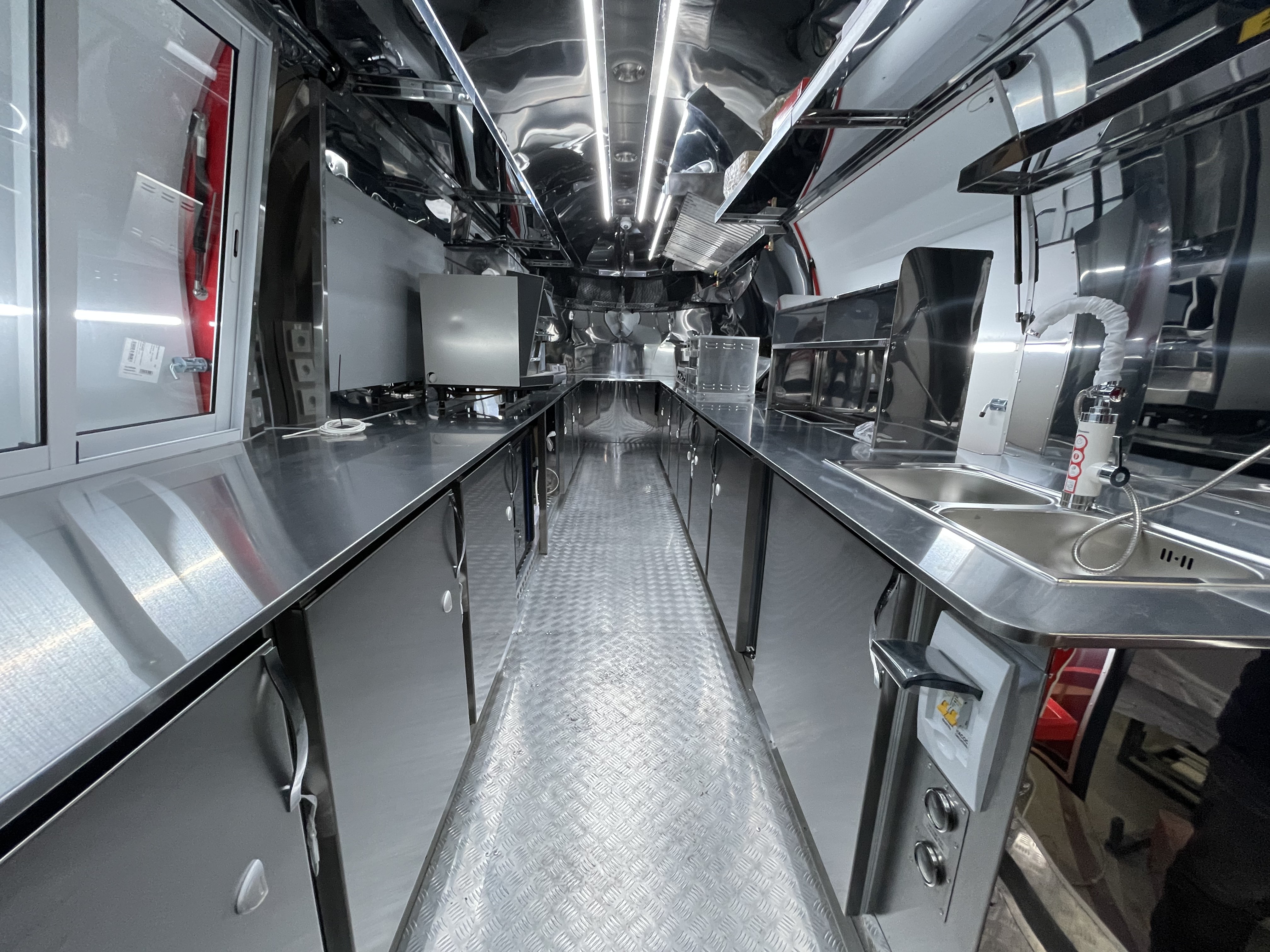
The hero photograph shows a real MOBITRUCK commercial-kitchen interior for component and record-planning context. It does not prove an inspection, approval or operating location.
01Start with an authority register, not a reminder app
Open the permits and inspection records already issued for the business. Create one row for each document. If the project is not open yet, use the food trailer permits guide to identify the agencies that must be contacted before the build is frozen.
Use these fields:
| Field | What to record | Why it matters |
|---|---|---|
| Control item | Exact permit, license, inspection, service or record name | Prevents a generic reminder such as "renew permits" from hiding separate obligations |
| Authority or provider | Agency, fire marshal, county health department, service company, insurer or vehicle authority | Shows who can confirm the requirement and who cannot |
| Scope | Business, specific trailer, commissary, vending site, employee or tow vehicle | Stops one approval from being reused for the wrong unit or location |
| Identifier | Permit, license, VIN, account, tag or report number | Connects the calendar to the evidence file |
| Issue and expiration dates | Dates printed on the current record | Establishes the working renewal window |
| Internal start date | The date staff should begin the renewal or service task | Leaves time for forms, appointments, corrections and evidence |
| Owner | One named person responsible for the next action | Avoids a shared task with no accountable operator |
| Evidence | PDF, receipt, inspection report, service tag, photograph or portal confirmation | Makes the record retrievable during an inspection or renewal |
| Change trigger | Menu, equipment, fuel, layout, ownership, commissary, county, site or unit change | Captures reviews that occur before the printed expiration date |
| Status | Current, due, submitted, correction required, closed or not applicable | Makes the calendar useful in weekly operations |
Do not populate missing dates from a blog, another operator's permit or a template. Mark the field "authority confirmation required" and contact the issuing office. The calendar becomes reliable only when every deadline traces to a current document or official instruction.
02Separate the five compliance lanes
The U.S. Food and Drug Administration publishes the Food Code as a model. States, counties, cities and Tribal jurisdictions adopt and administer their own versions. FDA's 2026 Food Code therefore helps explain the regulatory framework, but it is not a substitute for the code and procedures adopted where the trailer will operate.
Build the register by lane:
- Food establishment: mobile-food permit, plan review, commissary or base agreement, food-manager credentials, employee food-safety records, water and waste records, and required inspection reports.
- Fire and fuel: mobile-vending fire permit where required, extinguisher service, hood-suppression service, LP-gas inspection or test records, generator conditions and corrections issued by the fire authority.
- Business and tax: entity filings, local business-tax receipt or license, sales-tax account, insurance renewals and any required employer records.
- Operating site: property authorization, zoning or land-use clearance, event approval, county reciprocity or added-county authorization, parking rules and commissary-return duties.
- Vehicle and towing: registration, title, VIN and certification records, axle and brake records, tow-vehicle limits, insurance, and any periodic inspection that actually applies to the operation.
Assign each row to the party that controls it. The operator normally owns permits, sites, daily food-safety records and renewal submissions. A licensed service company may inspect or service fire equipment. A builder supplies records for its contracted construction scope. The authority decides whether the submitted unit and operation meet its rules.
03Use a three-speed calendar
Not every control belongs on an annual list. Run the calendar at three speeds.
Before each service day
Keep this list short enough that a manager can complete it:
- confirm the authorized site and any time restrictions;
- verify potable-water supply, wastewater capacity and required commissary servicing;
- check refrigeration and hot-holding temperatures with the records required by the local food authority;
- inspect the exit path, cooking area and required fire equipment for visible problems;
- check lights, tires, coupling, safety chains, breakaway equipment and brakes before towing;
- record any failure, remove unsafe equipment from service and assign the corrective action.
These are operating checks, not substitutes for an inspection, professional service or authority record. The pre-pickup inspection guide covers the handoff inspection before a completed unit enters the operator's routine.
Monthly management review
Once a month, review the next 120 days rather than looking only at the current month. Check expiring records, open corrections, staff credentials, service appointments, insurance certificates and sites scheduled for events. Confirm that every digital record opens and that the paper copies required on the unit are present.
The monthly review should also compare the current trailer with its approved or submitted plan. A newly installed appliance, moved hand sink, changed fuel source or revised service window can matter before the next renewal date.
Dated and event-triggered controls
Enter only intervals supported by the applicable authority or provider. The following examples show why a copied national calendar is unsafe:
| Control | Working rule for the calendar | Boundary to preserve |
|---|---|---|
| Food permit or license | Enter the expiration and renewal instructions printed by the issuing jurisdiction | Names and terms differ; confirm with the agency that licenses the unit |
| Health inspection | Track the last report, corrections and next authority action | Inspection frequency may be risk-based, event-driven or set by local law |
| Portable fire extinguisher | Where OSHA's employer-use rule applies, document monthly visual inspections and the annual maintenance check | OSHA scope and exemptions matter; fire-code and local-permit duties may add different requirements |
| Hood suppression | Use the service interval on the applicable system record and local fire requirements | Do not infer one national interval from a single city's page |
| LP-gas system | Track the current inspection or test record required by the local fire authority and service provider | Fuel configuration and jurisdiction determine the requirement |
| Vehicle periodic inspection | If the unit is a commercial motor vehicle subject to 49 CFR 396.17, keep evidence of a qualifying inspection performed within the preceding 12 months | Not every food trailer or tow combination falls under the federal motor-carrier rule; verify applicability |
| Insurance | Enter the policy expiration, certificate requests and lead time supplied by the carrier | Coverage is not a permit and does not prove code compliance |
Two concrete records deserve close attention. A fire-suppression service tag should identify the system and service status; it is not a health inspection. The vehicle certification label and VIN identify the rolling vehicle and manufacturer record; they do not approve menu, plumbing, equipment or a vending site.
04Add a change-trigger matrix
Dates alone will miss some of the most expensive compliance failures. Add a second sheet that asks what must be reviewed before a change is released.
| Proposed change | Authorities or specialists to ask before work starts | Records to update |
|---|---|---|
| New menu or cooking method | Food authority, builder and fire authority when heat, grease or fuel changes | Menu, equipment list, plan-review file, fire scope and operating procedures |
| New or relocated equipment | Food authority, licensed trade contractor, builder and fire authority as applicable | Floor plan, cut sheets, load schedule, installation record and inspection file |
| Generator, shore-power or electrical change | Qualified electrical professional, builder, fire authority and site operator | Load calculation, one-line or circuit record, equipment documentation and site rules |
| LP-gas addition or modification | Qualified LP-gas professional and local fire authority | Piping diagram, test or inspection record, appliance list and service tags |
| Commissary or base change | Licensing food authority and the new facility | Agreement, route or servicing records, permit file and contact details |
| New county or city | Food authority, zoning or land-use office, fire authority and event or property operator | Local authorizations, site approval, inspection records and calendar entries |
| Ownership or business-name change | Each issuing agency, insurer, tax authority and finance provider | Licenses, registrations, insurance, contracts and displayed notices |
Florida provides a useful plan-review example. The state's Mobile Food Dispensing Vehicle guide says plan review is required for a new or unlicensed vehicle, a vehicle closed for more than 18 months, or a remodeled vehicle. That is a trigger, not an annual renewal rule.
Georgia and North Carolina show why location belongs in the same system. Georgia's mobile-food guidance uses a county-of-origin framework and added-county authorizations. North Carolina's rules require the permit holder to provide the regulatory authority a list of counties and locations and keep it current; they also address daily servicing at the permitted commissary. Those state examples should not be copied into another jurisdiction's calendar.
Austin Fire offers a local fire example. Its current mobile-food page lists an annual fire permit, current annual extinguisher tags, a semiannual suppression-system tag for applicable new units and an annual LP-gas pressure-test report. Enter those intervals only for an operation governed by that authority or after the local fire authority confirms the same requirement.
05Build an inspection-ready evidence file
Use the same name for the calendar row and its evidence folder. A practical file structure is:
01-food-authorityfor permits, plan review, inspection reports, corrections and commissary records;02-fire-and-fuelfor fire permits, extinguisher records, suppression reports and LP-gas documents;03-sitefor property consent, zoning, event and county authorizations;04-vehiclefor title, registration, VIN or certification record, axle and brake documents and applicable inspection evidence;05-businessfor entity, tax, insurance and employer records;06-change-controlfor approved drawings, equipment cut sheets, contractor records and authority correspondence.
Name files with the date, unit identifier and document type. Keep the original record. Store a readable working copy where staff can retrieve it without searching personal email. If an authority requires a physical document on the trailer, list that requirement in the calendar and verify the copy during the monthly review.
The food trailer document package guide explains what a buyer should request at handoff. The compliance calendar continues that package after delivery; it does not replace it.
06Put build responsibility beside operating responsibility
MOBITRUCK prepares the shell system at its manufacturing operation in Estonia. In the current U.S. path, Concession Nation assembles the rolling shell and, within its signed scope, issues the American VIN and MCO and completes the applicable vehicle-certification work for that stage. Concession Nation or another qualified U.S. builder may complete the final build under a separate scope.
The operator still needs an authority-specific operating file. A builder cannot promise health, fire, site or business approval on behalf of the agency that controls it. An independent builder also needs to document its own equipment, electrical, plumbing, gas, fire-suppression and final-build scope.
Before signing, place each handoff record in the responsibility matrix:
| Record or action | Primary source | Calendar owner after delivery |
|---|---|---|
| Shell specification and supplied-component records | MOBITRUCK scope documents | Operator keeps with permanent unit file |
| VIN, MCO and applicable rolling-shell certification record | Concession Nation for the current U.S. path and contracted scope | Operator keeps with vehicle records |
| Final equipment and trade records | Final builder and licensed contractors within their scopes | Operator tracks service, changes and authority submissions |
| Food, fire, site and business approvals | The controlling authorities | Operator or named compliance manager |
| Corrections and renewals | Authority, provider and responsible contractor as applicable | One named operator-side owner until closed |
Use the build and inspection sequence to decide when each record should exist. Waiting until opening week turns missing documentation into a schedule problem.
07Set up the calendar in 30 minutes
- List the operating state, county, city, commissary and first vending site.
- Add the exact unit identifier and tow vehicle used for the operation.
- Enter every current document with its authority, issue date, expiration date and evidence link.
- Add the next 120-day internal review date for items without a near-term deadline.
- Build the change-trigger sheet for menu, equipment, fuel, electrical, plumbing, ownership, commissary and location changes.
- Assign one person to each row and one backup for time-sensitive renewals.
- Ask every issuing authority to confirm blank or uncertain intervals in writing or through its official portal.
- Review the register monthly and after every approved project change.
The professional decision is simple: if a row lacks an authority, owner or evidence file, it is not controlled. Fix the record before treating the item as current.
08Questions about a food trailer compliance calendar
Is there one food truck compliance checklist for every state?
No. FDA's Food Code is a model, while states and local authorities adopt and administer their own rules. Fire, site, business and vehicle requirements also come from different authorities. Use a national template only to organize questions, then replace every deadline with the rule or document for the actual jurisdiction.
How early should I start a renewal?
Use the issuing authority's instructions and add an internal lead time for forms, appointments, corrections and payment. If the authority gives no lead time, ask it directly rather than inventing a universal 30-, 60- or 90-day rule.
Does an annual permit cover equipment changes during the year?
Not necessarily. Menu, layout, equipment, fuel, electrical, plumbing, ownership, commissary or operating-location changes can trigger review before the permit expires. Put change control beside the date calendar.
Who is responsible for keeping the calendar current?
The operator should name one person for each item. Builders, service companies and authorities may supply records or decisions, but the operator needs to collect them, track deadlines and close corrections.
Does a VIN or vehicle inspection approve the kitchen?
No. Vehicle records address the rolling vehicle and applicable road-use requirements. Food, fire, equipment, trade and site approvals remain separate and depend on the final build and operating jurisdiction.
09Sources checked October 1, 2026
- FDA: Food Code 2026 — current model Food Code and its role as a model offered for jurisdictional adoption.
- FDA: State Retail and Food Service Codes and Regulations by State — official starting directory for adopted state rules.
- OSHA 29 CFR 1910.157 — portable-extinguisher inspection, maintenance and training provisions where the standard applies.
- eCFR 49 CFR 396.17 — periodic vehicle-inspection rule for commercial motor vehicles within its scope.
- Florida DBPR: Mobile Food Dispensing Vehicle Guide — Florida licensing and plan-review triggers.
- Georgia Department of Public Health: Mobile Food Service FAQ — county-of-origin and added-county operating framework.
- North Carolina: Rules Governing the Food Protection and Sanitation of Food Establishments — mobile-food location-list and commissary provisions.
- Austin Fire: Mobile Food Vending Fire Inspections — one local example of fire-permit and service-record intervals.
10Next step
Create the first register with the real unit, commissary and operating location. Email it with the menu, equipment list and build path to [email protected] for a video-call review of the shell and builder handoff. Confirm every permit, inspection and renewal with the authority that controls it.
 Authority map