Seafood fry-line decision memo · Official-source review October 11, 2026
Leave the fryer count blank until every seafood item has a product label, a receiving state and an accepted cooking path. A box of breaded shrimp may contain a raw product, a manufactured not-ready-to-eat product with cooking instructions or a fully cooked item. Those states create different work inside the same trailer.
This memo gives the operator and final builder a release decision: approve the hot line only when the menu has been classified and the raw, clean, oil and waste routes fit at the same time. Sources were checked on October 11, 2026. The 2026 FDA Food Code is a model used by jurisdictions; the authority responsible for the actual operation applies its adopted rules.
01Decision requested
Choose one operating basis for each launch item:
- raw seafood prepared and cooked on the trailer;
- manufactured not-ready-to-eat seafood cooked according to its label and accepted procedure; or
- ready-to-eat seafood reheated, hot-held or finished for service.
Do not classify an item by appearance. Read the package, specification sheet and cooking statement. Record whether it arrives fresh or frozen, intact or comminuted, breaded or unbreaded, reduced-oxygen packaged or conventionally packaged and raw or fully cooked. Keep the supplier record with the menu file.
The recommended launch basis is the narrowest one that supports the menu and volume target. If the operation can begin with ready-to-eat or clearly labeled manufactured product, the team can evaluate that line without assuming the prep and separation duties of raw seafood. That recommendation does not decide food safety for the operator. The product record and regulatory authority control the accepted process.
02Product-state matrix
Use this matrix as the evidence object for the equipment meeting. Complete one row per product, not one row per menu name. Fish, crustacean shellfish and molluscan shellfish may need different supplier, allergen and handling records even when they share a fryer.
| Product state | Evidence required before layout release | Work the line must support | Hold the equipment decision when |
|---|---|---|---|
| Raw seafood | Supplier and package identity, species, receiving condition, storage instruction, preparation step, cooking control and authority review | Protected receiving, raw storage, thaw or slack procedure if used, raw prep, transfer to cooking, temperature verification and separation from ready-to-eat food | The product state, cooking endpoint or raw-to-ready route is unresolved |
| Manufactured not-ready-to-eat | Current package label, manufacturer cooking instructions, storage direction and any required control statement | Frozen or refrigerated storage, package opening, cooking from the specified state, verification, holding and a way to keep uncooked product from being mistaken for ready-to-eat food | Staff would have to infer doneness from color, breading or package graphics |
| Ready-to-eat | Supplier record, fully cooked statement, storage and reheating or service instruction | Protected cold storage, portioning, reheating or finishing as applicable, hot or cold holding, assembly and clean utensil control | The record does not establish that the product is ready-to-eat |
Add columns for package size, daily quantity, backup quantity and disposition at closing. The table should reveal the physical work. It should also expose a menu item that has been described too loosely for the builder to use.
FDA Food Code 2026 section 3-401.15 addresses manufacturer cooking instructions and ingredients or products that require further processing. Section 3-302.11 addresses separation of raw animal foods from ready-to-eat food and other protected products. Those provisions are useful design inputs. They do not replace the local plan review or the product manufacturer's instructions.
03Release condition 1: prove the cold path
Draw receiving through the service refrigerator before placing the fryer. Frozen product needs reserve capacity and a refill route. Refrigerated raw product needs protected storage and a transfer that does not cross ready-to-eat garnish, clean packaging or the pickup area.
The 2026 FDA model code says stored frozen food is maintained frozen. For time/temperature control for safety food, section 3-501.13 includes thawing under refrigeration at 41°F or less, controlled running-water conditions and thawing as part of an allowed cooking process. The same section has a specific rule for reduced-oxygen-packaged fish bearing a keep-frozen statement: it is removed from that environment before refrigeration thawing, or before or immediately after the stated running-water thawing procedure. Put that label direction on the product row when it applies.
Cold storage is released only after the team records package dimensions, cases on hand, replenishment frequency, door swing and the refrigeration model's installation requirements. A cubic-foot estimate will not show whether the intended cases fit or whether an open door blocks the cook.
The FDA model holding provision uses 41°F or less for cold-held TCS food and 135°F or above for hot-held TCS food, subject to its stated exceptions and accepted procedures. These numbers are not a substitute for classifying the actual product. Write the accepted receiving, holding, monitoring and corrective-action method beside the item.
04Release condition 2: separate raw work from finished orders
Mark four points on the plan: raw landing, cooking transfer, ready-to-eat assembly and customer handoff. Now trace a worker changing tasks. The hand sink must remain convenient and available; payment, raw packaging and waste should not force a shortcut across the clean assembly area.
Raw seafood prep may introduce knives, pans, breading containers, batter tools and food-contact surfaces that must leave the ready-to-eat route. A manufactured frozen product cooked from the package may remove some prep steps, but it still needs a controlled uncooked-product path. A fully cooked product changes the process again.
Cooking controls follow the item. Under section 3-401.11 of FDA's 2026 model code, fish generally falls under the 145°F for 15 seconds provision unless another listed category or exception applies; comminuted fish is covered by a different time-and-temperature provision, and stuffed fish by another. The operator should not turn that summary into a universal wall chart. Put the applicable product, procedure, instrument and authority-accepted control into the operating file.
If the raw route cannot be drawn without crossing ready-to-eat assembly, revise the menu or the work line. Adding a colored cutting board does not repair a failed traffic path.
05Release condition 3: size the fry station as a system
The fryer schedule starts with the launch products, batch size and recovery requirement. For each item, record the cooking medium, load per batch, cook procedure, drain time, finish step and holding limit. Run the intended mixed ticket. A fish portion and a shrimp portion may share oil only if the operator's allergen and product procedures allow it; a non-seafood side introduces another decision.
Fish and Crustacean shellfish are major food allergens under federal labeling law. FDA also explains that the species of fish or Crustacean shellfish is declared for covered packaged foods. Molluscan shellfish such as oysters, clams, mussels and scallops are treated differently under the major-allergen definition. Keep the actual labels and species records. The layout can support an allergen procedure, but it cannot promise that shared equipment produces an allergen-free order.
Do not treat used oil as an afterthought. Show the cool-down or transfer procedure, approved container, storage position, service route and pickup or disposal responsibility. Keep hot oil away from the customer edge and the normal path to the exit. OSHA's restaurant-safety material identifies burns during fryer operation, cleaning, straining and moving oil, and it warns against pouring water or ice into hot oil.
Ventilation, fire protection and fuel or electrical design are selected from the actual appliances and the rules applied by the reviewing authorities. The FDA model code requires ventilation capacity sufficient to prevent grease or condensation from collecting on walls and ceilings. The fire authority, equipment listings, installation manuals and qualified trades establish the project-specific hood, suppression, exhaust, makeup-air and clearance package.
Hold the fryer purchase if the cooking fuel, hood package, fire review or oil route remains open. A fryer can fit the counter and still fail the project.
06Release condition 4: design the cleaning shift
Seafood fry lines produce two different cleaning problems. Food-contact tools move through washing, rinsing, sanitizing and air-drying. Grease and breading residue also accumulate around baskets, filter equipment, floors and nonfood-contact surfaces.
FDA Food Code 2026 section 4-301.12 generally calls for at least three sink compartments for manual washing, rinsing and sanitizing, with compartments large enough for the largest item unless an approved alternative applies. Section 4-301.13 calls for drainboards, racks or tables sized for the soiled and cleaned items that accumulate. Put the fryer basket, raw prep pan, breading container, largest utensil and removable equipment part into the fit review.
Write the end-of-service route in order:
- stop production and protect remaining food;
- identify food disposition and move raw and ready-to-eat items under the accepted procedure;
- handle oil only under the equipment and workplace procedure;
- move removable food-contact parts to the dirty landing area;
- wash, rinse, sanitize and air-dry through the accepted warewashing process; and
- clean the fryer area, hood-access surfaces, floor and waste route without spraying open food or clean equipment.
Test the closing shift on the drawing. One person should be able to reach the hand sink while dirty fryer parts occupy the landing area. Clean parts need protected drying space outside the raw receiving and oil routes.
07Release condition 5: carry the real line into utilities and weight
Create two operating cases. The rush case includes the fryers under the proposed batch pattern, refrigeration cycling, ventilation and makeup air, HVAC, water heating, pumps, lighting, point of sale and any holding or warming equipment. The closing case includes the equipment that remains on while warewashing, oil handling and cleanup occur.
For every selected appliance, capture the exact model, listing or certification information requested by the project, voltage, phase, frequency, rated input, plug or hardwire connection, fuel data, ventilation duty, clearances, drain or water needs and service access. The final electrical and fuel design belongs to qualified project professionals and the signed builder scope.
Carry the fryers, hood and suppression components, refrigeration, sinks, tanks, cooking oil, product inventory, packaging, waste, people and any generator or batteries into the food trailer weight budget. Use completed-unit ratings and actual scale evidence when available. A shell-family description does not establish payload for a finished seafood trailer.
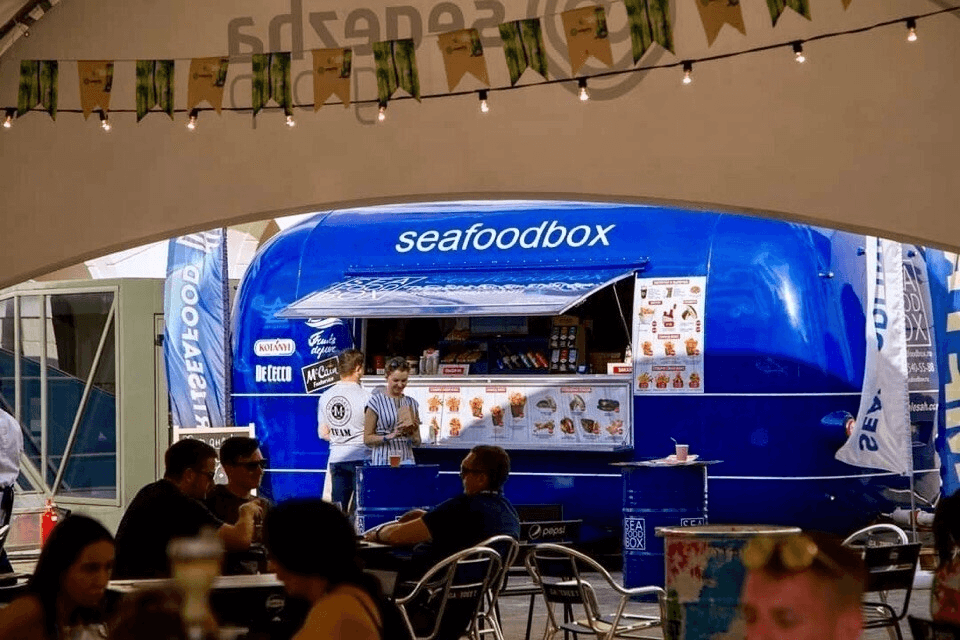
The archived Seafoodbox project documents a real MOBITRUCK specialty-food unit with a broad event-facing service side and illuminated exterior. It can inform customer frontage and evening visibility. The archive does not establish the current equipment, fryer package, U.S. food approval or operating procedure for a new project.
08Approval record for the final builder
Release the layout with the product-state matrix, launch menu, current labels, supplier records, accepted cooking and holding controls, scaled flow drawing, equipment schedule, cold-storage calculation, mixed-ticket test, cleaning sequence, oil route and rush and closing load cases. Attach current cut sheets and installation manuals.
Assign purchase, installation, trade design, commissioning, authority corrections, operating procedures, maintenance and warranty in writing. A change from fully cooked shrimp to raw shrimp reopens cold storage, separation, cooking, cleaning and authority review. It is a process change, not a menu edit.
MOBITRUCK prepares the shell system at its manufacturing operation in Estonia. In the current U.S. path, Concession Nation assembles the rolling shell and, within its signed scope, issues the American VIN and MCO and completes applicable vehicle-certification work for that stage. Concession Nation or another qualified U.S. builder may complete the seafood application under a separate final-build scope.
Vehicle certification does not approve the food operation. Food, plumbing, electrical, fire, workplace, site and business reviews remain separate, and the responsible authorities make their determinations for the actual menu, equipment and location.
09Sources checked October 11, 2026
- FDA Food Code 2026 — current federal model code and jurisdictional-adoption boundary.
- FDA Food Code 2026 PDF — model provisions for product separation, cooking, manufacturer instructions, frozen storage, thawing, holding, warewashing, drainboards and ventilation.
- FDA: Food Allergies — current federal major-allergen and labeling context for fish and Crustacean shellfish.
- FDA allergen-labeling guidance, Edition 5 — fish and shellfish distinctions and current labeling guidance.
- OSHA restaurant safety: cooking — fryer burn, hot-oil handling and exhaust hazards.
- NHTSA importation and certification FAQs — vehicle-manufacturer, VIN and certification context for trailer stages.
Send MOBITRUCK the launch menu, product labels, first operating market, proposed batch plan and selected equipment records. We can review those inputs against a shell or rolling-shell configuration and list the unresolved items for the U.S. final builder. Request a configured project review.
 Physical project reference
 Related hot-line guide
 Electrical planning